Be Heard, Gain Insight, and Change
Anxiety, addiction and relationship specialist in Crouch End
Feeling Overwhelmed, Stuck, or Worn Down by Dread or Anxiety?
If you are struggling with ongoing worry, panic, compulsive habits, or relationship difficulties, you are not alone.
Many people come to therapy feeling exhausted by their thoughts, unsure why things have not improved, or quietly fearing that something is wrong with them.
Accredited Counsellor and Psychotherapist in Crouch End
I’m Andrew Martin, an accredited counsellor and psychotherapist with over 21 years of experience, based in Crouch End (N8) North London.

I specialise in working with people who feel caught in ongoing anxiety, worry, dread, or a persistent sense that something is not quite right. This includes anxiety disorders such as social anxiety, OCD, health anxiety, generalised anxiety disorder, and other long standing patterns of fear and worry.
I also work extensively with addiction and compulsive behaviours, and with relationship difficulties for individuals and couples.
My approach is calm, supportive, and practical. I help people understand what is keeping them stuck, while gently building the skills and confidence needed to feel more grounded and in control again. Therapy with me is about taking the time to understand what you are carrying, whether that is anxiety, sadness, or something harder to name, and gently supporting the kind of change that helps things begin to feel different, not just talked about.
My Approach to Counselling
The best counselling works when the approach matches your needs and goals, whether you want to explore the past or focus on practical solutions.
My integrative approach combines evidence-based therapies such as Cognitive Behavioural Therapy (CBT), Rational Emotive Behaviour Therapy (REBT), and Acceptance and Commitment Therapy (ACT), delivered in a supportive and collaborative style.
I specialise in helping people manage anxiety disorders, overcome addictive or compulsive behaviours, and work through relationship difficulties. My practice is based in Crouch End (N8), and I also work with many clients from the nearby Muswell Hill (N10) area. My goal is to provide counselling and psychotherapy that gives you both insight and practical tools to make lasting changes.
Click here to learn more about my qualifications and experience.
What To Expect
Your first counselling session is an opportunity for us to get to know each other and to explore what has brought you here. We might talk about the difficulties you are facing, such as anxiety, stress, OCD, health anxiety, panic attacks, or relationship challenges. This is also a chance for you to ask me questions about the counselling process, and I will explain everything as clearly as possible.
I will outline important aspects such as confidentiality, my approach to therapy, and what working together might look like. By the end of the session, you should have a good sense of whether you feel comfortable with me and whether you’d like to continue.
From my side, I will listen carefully, begin to understand your concerns, and share initial thoughts on the therapeutic direction I recommend. If we both feel there is a good fit, we can agree on a regular weekly session. These sessions are your dedicated time, giving you consistency and space to focus on change.
Counselling sessions usually last 50 minutes and take place at The Vale Practice in Crouch End (N8). I also work with many clients from Muswell Hill (N10), Highgate, and across North London, and my goal is to provide a space where you can make lasting changes.
What do you need help with?
I specialise in counselling for anxiety disorders, addictive behaviours, and relationship difficulties. Many people come to me for help with issues such as OCD, health anxiety, social anxiety, panic attacks, stress, or alcohol use. Others want support with relationship problems, whether as an individual or as part of a couple.
You can click on any of the topics below to read more about how I work with these difficulties and the types of therapy that may help.
I’m always happy to answer questions, so please feel free to contact me.
Private Healthcare Insurance
I am a registered provider with many of the leading private healthcare organisations. If you have private health insurance that covers counselling, psychotherapy, or addiction counselling, you may find that they will pay for some of the cost of seeing me.
I am a registered provider with Aviva Healthcare, Cigna Healthcare, WPA, and Vitality Health.
If your healthcare provider isn't mentioned above, it's still likely they may cover your treatment. Please feel free to email me so we can discuss it further. Unfortunately, I do not work with patients insured by Axa PPP or BUPA. I’m sorry for any inconvenience this may cause.







Article: The Four Horsemen of the Relationship Apocalypse
Most couples don't set out to hurt one another. In fact, many of the couples I meet care deeply about each other. The difficulty is that when relationships become strained, people can find themselves caught in patterns of communication that leave both partners feeling hurt, misunderstood and disconnected.
The relationship researcher Dr John Gottman spent decades studying couples and identified four communication patterns that were strongly associated with relationship distress. He called them the "Four Horsemen of the Apocalypse": criticism, defensiveness, contempt and stonewalling.
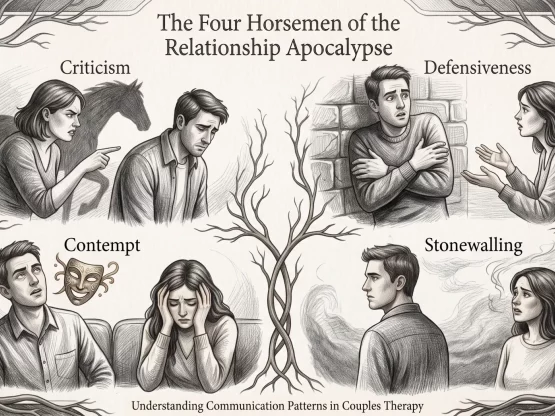
Although the name sounds dramatic, these patterns are surprisingly common. Most of us will recognise at least one of them in our own relationships. The important thing is not whether they happen occasionally, but whether they become the usual way of relating to one another.
Criticism
Criticism goes beyond expressing a complaint about a specific behaviour. Instead, it attacks the character of the other person.
For example, saying "I felt disappointed when you forgot to call" is very different from saying "You never think about anyone except yourself." Criticism often develops when frustrations have been building up for some time. What begins as disappointment can gradually turn into blame.
Defensiveness
When people feel criticised, they often become defensive. They may explain themselves, make excuses, deny responsibility or point out what their partner has done wrong.
Defensiveness is usually not a sign that somebody doesn't care. More often, it is an attempt to protect themselves from feeling blamed, judged or inadequate.
Unfortunately, when both people are busy defending themselves, neither feels properly heard.
Contempt
Of the four horsemen, contempt is generally considered the most damaging.
Contempt involves communicating from a position of superiority. It can appear as sarcasm, eye-rolling, mockery, dismissive comments or speaking to a partner with obvious disrespect.
Contempt often develops when hurt and resentment have been left unresolved for a long time. The warmth and goodwill that once existed begin to give way to frustration and bitterness.
Stonewalling
Stonewalling occurs when one partner emotionally withdraws from the conversation. They may become silent, look away, leave the room or stop responding.
This behaviour is often misunderstood. In many cases, the person who is stonewalling is not trying to ignore their partner. They may simply feel overwhelmed.
When emotions become too intense, our ability to think clearly and listen effectively can begin to shut down. At that point, productive conversation becomes very difficult.
Recognising the Pattern
One of the most hopeful findings from Gottman's research is that healthy relationships are not free from conflict. Successful couples disagree, become frustrated and occasionally get things wrong, just like everyone else.
The difference is that they learn to recognise these patterns and respond differently.
Behind criticism there is often hurt. Behind defensiveness there may be shame or fear of being judged. Behind contempt there is frequently resentment and disconnection. Behind stonewalling there is often emotional overwhelm.
When couples begin to understand what is happening beneath the surface, conversations can become less about proving who is right and more about understanding one another's experience.
Recognising the four horsemen is not about labelling a relationship as good or bad. Instead, it offers a useful way of understanding the patterns that may be keeping a couple stuck and provides a starting point for creating healthier, more connected conversations.

Client's Experience
Therapy offers a space to better understand yourself and your emotional responses. It can help you to recognise patterns in your relationships, make sense of past experiences, and find new ways of relating to yourself and others.
Clinic Locations
Crouch End N8
Parking in Crouch End
For counselling or psychotherapy in Crouch End, North London, there is free parking most of the day with some exceptions. Try to leave an extra ten minutes just in case it is hard to get a space.
Get in touch
Feel free to contact me if you have any questions about how counselling works, or to arrange an initial assessment appointment.
This gives us a chance to discuss what has brought you to counselling, whether it may be helpful for you, and whether I am the right therapist to support you.
All enquiries are treated in the strictest confidence and handled securely. I will respond to your message as soon as I am able.